
By Princeley Njukang, Cameroon
The St. Joseph’s Children and Adults Home (SAJOCAH), an institution that offers rehabilitation and education services to persons with disabilities, has urged parents of children with disabilities to stop hiding their children and send them to school. The call was made on November 14, 2026, as the institution celebrated its 50th anniversary in Mambu, Bafut, a village located 20 kilometres from Bamenda, in Cameroon’s North West Region.
During a Golden Jubilee Mass officiated by the Auxiliary Bishop of the Archdiocese of Bamenda, John Berinyuy Tatah, religious, traditional and administrative authorities joined the SAJOCAH family to reflect on the institution’s achievements over the years and commit to doing more for persons with disabilities in the years ahead.
“SAJOCAH has proven over the years that each human being has a dignity. Before, those who were suffering from disabilities were always locked in their houses. Some were even killed because people thought that they had no use,” the Bishop said.


“The true measure of this centre’s success is not simply the number of years it has existed, but the positive difference it has made in the lives of the people it serves,” she said.
From Passion to Legacy
SAJOCAH reportedly began as a passion project by Sister Lydia Pardeler of the Tertiary Sisters of St. Francis, who was concerned about the humiliating treatment and neglect faced by persons with disabilities. Her initial idea was simply to gather these persons, feed them, teach them basic skills and remind them that they were loved.
One account holds that she used to gather the children and then ask neighbours to host them. When the number of children became difficult to manage under such arrangements, the need for a formal institution became undeniable. In 1976, Sister Lydia secured support from the Archdiocese of Bamenda to formally establish SAJOCAH.
The institution initially operated only Physiotherapy and Orthopaedic sections before later adding a Resource Room, where persons with visual impairments could learn Braille, mobility, orientation and daily living skills, and pursue their education.
The Impact
SAJOCAH’s administration reports that the institution has directly and indirectly impacted the lives of over 24,000 persons with various disabilities, many of whom have gone on to excel in different spheres of life. Beyond providing rehabilitation and education, the institution says it has worked to challenge the misconceptions that continue to deny persons with disabilities the opportunity to live full lives.
“Persons with disabilities are not defined by their limitations. They are individuals with talents, ambitions, abilities and dreams,” Sister Angela said. “Given the right opportunities, appropriate support and an accessible environment, they can learn, work, create, lead and contribute meaningfully to society,” she added.
Prince Nsah Edwin, a journalist with visual impairment who served as one of the anniversary’s masters of ceremonies, said he was not sure he would have come this far without SAJOCAH. He revealed that his father had been advised to do away with him because of his blindness.
“My father became a laughing stock among his fellow traditional rulers as soon as they found out that I was born blind,” Edwin said as he took the microphone. “Disability is not inability,” he affirmed, to the cheering of the crowd.

“The belief was that blind people cannot go to school. I was already given names like financial drainer, wizard and curse,” he said.
The academic remarked that SAJOCAH has played a leading role in championing empowerment, inclusion and dignity for persons with disabilities. “Thanks to SAJOCAH, some of us have become doctors,” he added.
He said five visually impaired persons trained at SAJOCAH’s Resource Room have earned PhDs, while many others have moved into entrepreneurship, journalism and other fields, where they are “doing amazing”.
A Moment of Recognition
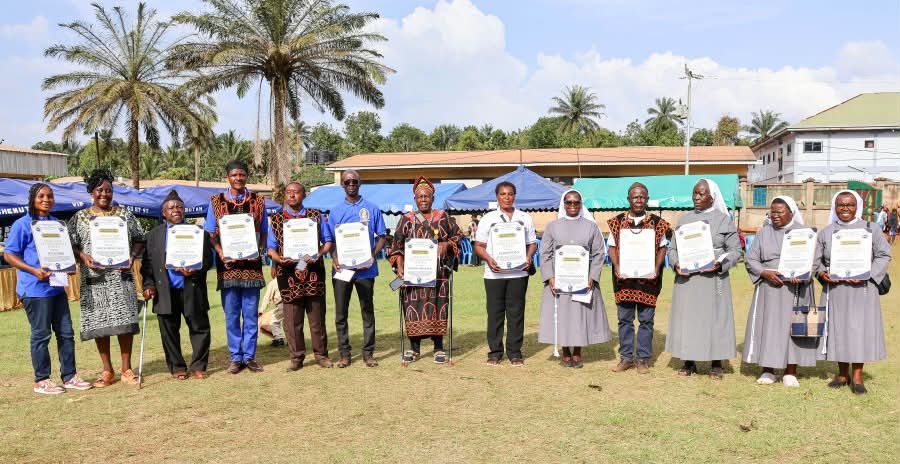
The anniversary also provided an opportunity to honour some of the people who have served SAJOCAH over the last half-century. Special Papal blessings were presented to Mary Ngum, the institution’s first cook, and Dr. Eveline Lukong, a teacher in the Resource Room.

November 14, 2026
According to SARREPSA representative, Dr. Ngong Peter, the awards were intended to communicate how much the alumni appreciated the impact the staff had made in their lives.
“All SAJOCAH staff should normally get an award, but we were not able to award everybody at this time,” he said.

The SARREPSA members reminisced about their time at SAJOCAH and the sometimes tense relationships they had with staff, saying they did not realise the good that was being done for them at the time.
“We are very grateful and will continue to do our best to support SAJOCAH,” Dr. Ngong said during a gala organised by SARREPSA on the eve of the anniversary. At the event, SARREPSA announced the donation of five white canes and several reams of Braille paper to support current pupils and students of the Resource Room.
Challenges Remain
SAJOCAH said its ability to expand its work into more communities has been impeded by several challenges, including the decade-long conflict in Cameroon’s Anglophone regions and the shrinking donor space, characterised by global funding cuts.

“We are unable to go for outreach programmes because moving with the children is difficult without a bus,” Sister Angela said.
Bishop Tatah said contributing to the acquisition of the bus was a way to ensure that something impactful remained after the fanfare.
“Little drops of water will go a long way,” he said.
Although some funds were raised during the ceremony, the total amount was not disclosed. However, Sister Angela told the media that they were far from reaching their target, adding that the end of the anniversary should not mean the end of contributions.
The Next 50 Years
SAJOCAH admits that things are changing rapidly, and says its services are being modernized to match the changing needs. Ahead of its Golden Jubilee, the Resource Room was refurbished and equipped with computers. “It is to ensure that the pupils and students can learn how to use the computer and use it to research and improve themselves,” Dr. Kesah said, adding that “in this digital age, we cannot afford to be left behind.”
For SAJOCAH, the next 50 years will have to respond to the increasing need to adapt its services to changing realities, expand its reach into underserved communities, and ensure that persons with disabilities have access to the education, skills and opportunities needed to participate fully in society.
 Princely Kesah