
Princeley Kesah, Cameroon
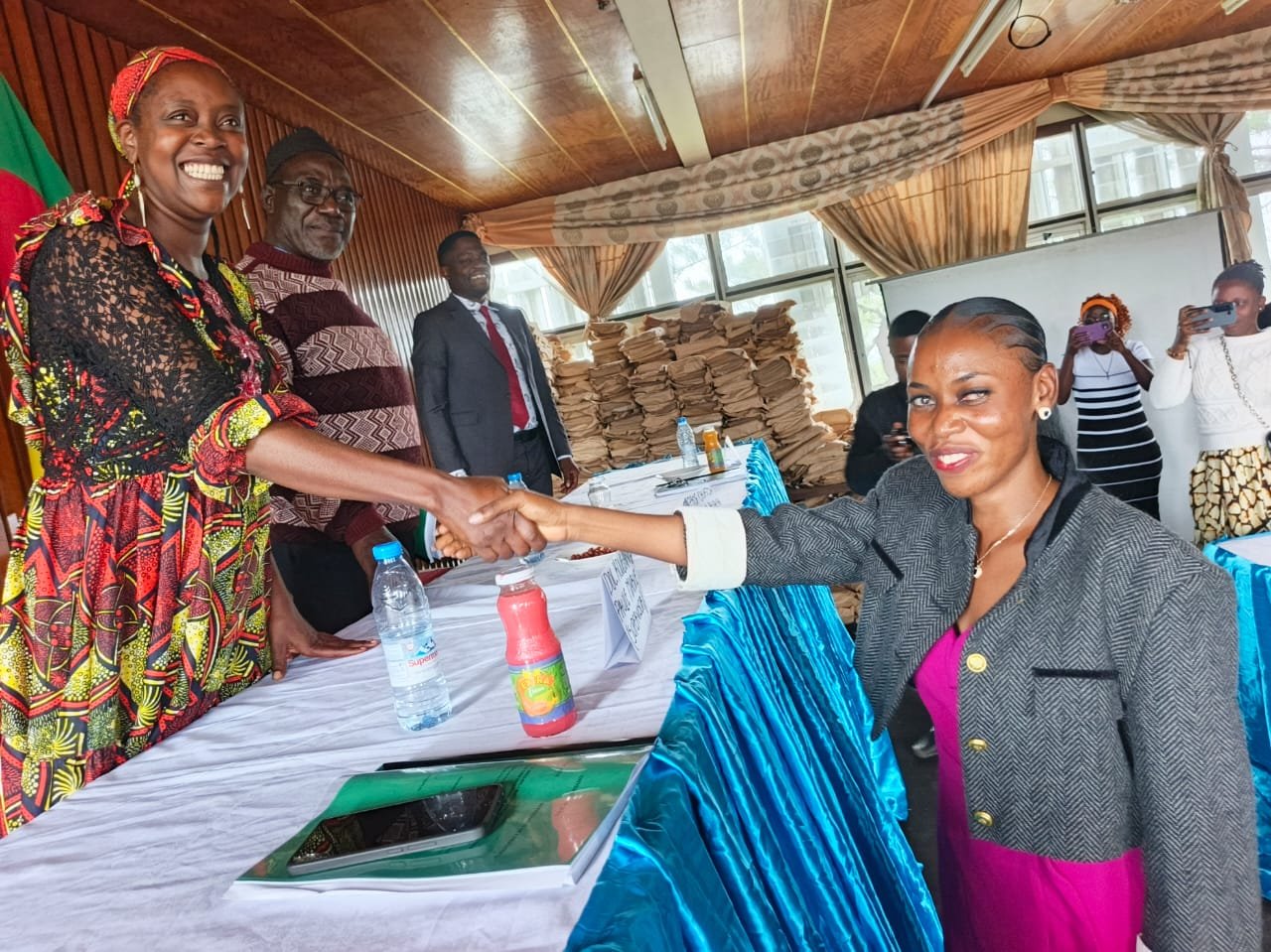
Adele Nguizana, 27, a woman with a vision impairment, has been worried for 14 years by the impact of braille errors on the academic performance of blind students like herself. Braille is a writing system widely used by millions of blind and partially sighted persons around the world.
Nguizana revealed in an interview with Disability News Africa that while in school, she wrote exams confidently, expecting to score high, only to sometimes end up with failing grades. During her undergraduate studies in Bilingual Studies at the University of Buea, Cameroon, a lecturer invited her to spell out certain words. This was after he had received the transcript of her Continuous Assessment. “I spelled them correctly and he asked why I wrote them wrongly. I explained to him that in braille, an unintended dot changes everything, and sometimes even a whole paragraph,” she said.
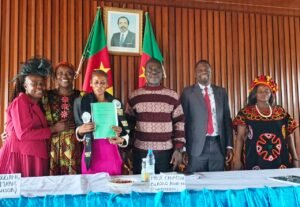
These experiences inspired Nguizana to base her Master’s dissertation research on the subject. If students with vision impairment now have a glimmer of hope that the unintended errors which often hamper their academic performance could soon be addressed, then it is thanks to Nguizana’s study. The dissertation, titled Linguistic Spelling Challenges of Braille User Students at the University of Buea, was defended recently at the boardroom of the university’s Faculty of Arts.
Despite studying so hard, some learners with vision impairment still end up scoring low and, in some cases, failing. For those who are born blind or who lose their sight at a tender age, they only hear words and never get to see their spelling. Sometimes, words are not spelled as they are pronounced. Using a descriptive qualitative design, the researcher examined nine braille scripts from two faculties of the University of Buea. Findings revealed significant errors resulting from the use of braille. The errors ranged from omission, insertion, substitution, transposition and grapheme substitution across two categories. The researcher recommends, among others, the integration of alternative assessment measures such as oral examinations and the use of computers for typing during examination sessions. This, the scholar suggested, would complement the use of braille. She equally encouraged learners with vision impairment to attend regular spelling lessons to improve their knowledge.
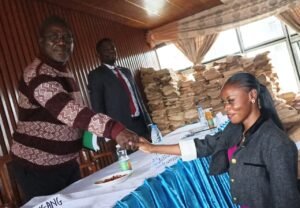
Speaking in an exclusive interview with DNA at the close of the session, Professor Blasius Chiatoh, chair of the defence panel, described the study as innovative, pertinent and timely. He said the study meaningfully identifies some of the challenges braille users face which hamper their academic performance, stressing that these students are not only graded on content but also on language. “We have to help them improve their language because it represents ideas, and presenting ideas in poor language is a serious issue,” he intimated.
Nguizana is the first person with a vision impairment to defend a Master of Arts dissertation in the Department of Linguistics, where the panel chair is currently Head of Department, and this means a lot to the department. “We are very delighted as a department that she has become the first to reach this level, and I do believe that this will open the pathway to others who may have been thinking that the Department of Linguistics is not inclusive enough,” he revealed. The academic emphasised that disability issues are understudied and undervalued within research in Cameroon, adding that once higher education begins paying attention to such neglected areas, it becomes incumbent on the state to take actionable steps to address policy gaps such as those raised in Nguizana’s study.
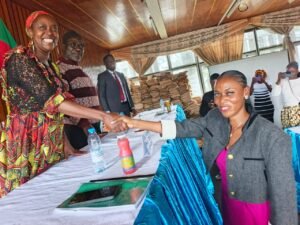
The dissertation supervisor, Dr Paule Marie Kougane, said it was not easy putting the research together due to difficulties accessing assistive technologies, adding that handling tables was particularly challenging. She, however, expressed delight that the candidate’s passion and determination saw them through to the finishing line. “It was really an interesting experience working with the candidate, and I am very happy we completed the research. I would be glad to repeat the process if I have the chance.”
Adele Nguizana was not born blind. She was sighted and attended a regular school, where she performed well. She was in Form Three when the unexpected happened. She had been experiencing pain in her eyes, but little did she know that blindness had come so near. One morning, she woke up and discovered she could no longer see anything. “I dropped out of school and was advised to enrol in a rehabilitation school to learn braille, mobility and orientation. Accepting my new reality was not easy, but I eventually did and went to the Rehabilitation Institute for the Blind in Buea, where I learned braille in 2012,” Nguizana recounted.
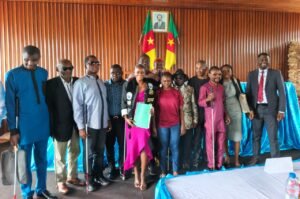
She returned to school after completing her braille lessons, hoping to excel just as she had before becoming a white cane user. It was then that she experienced first-hand the impact of braille errors on the performance of learners with vision impairment. At one point, she thought the problem was with her, but when her peers began raising similar concerns, she understood the gravity of the issue. However, real as the problem was, Nguizana did not have a solution for nearly 15 years. It was only when she enrolled for a Master’s degree in Applied Linguistics that she decided to research the problem in order to help other visually impaired peers who are held back not because they lack intelligence, but because they are disadvantaged by the mode of writing.
Speaking at the close of the defence, Nguizana’s mother said she could not be prouder of her daughter, stressing that Nguizana is the source of her hope and happiness. She may have been disappointed when her daughter lost her sight, but she now understands one thing that other parents of children with disabilities should also bear in mind:
“Disability is not inability.”
 Njukang Princeley