
By Princeley Njukang, Cameroon
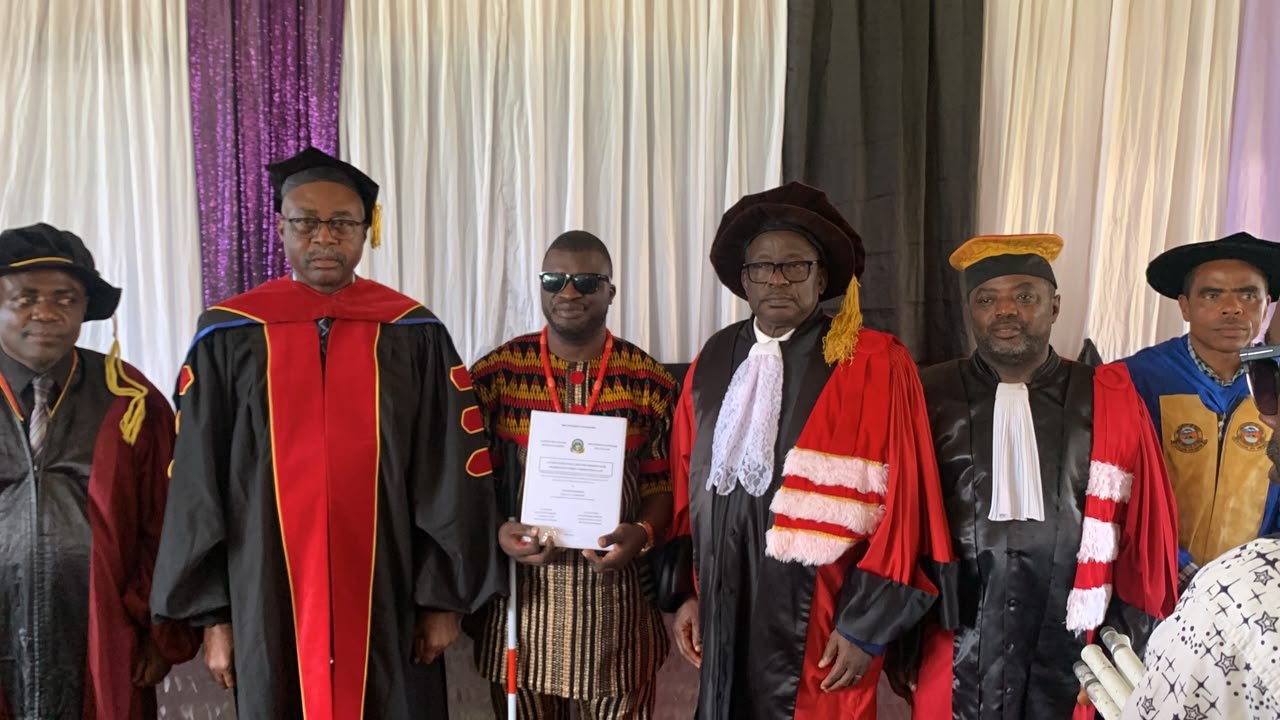
Despite numerous policy commitments, persons with disabilities in Cameroon continue to face exclusion from quality healthcare, a PhD thesis at the University of Bamenda’s Faculty of Law and Political Sciences has revealed. The thesis, titled Access to Healthcare for Persons with Disabilities Under Cameroonian Law, was defended by Kum Nji Desmond on October 29, 2026.
During the defence, Desmond pointed to legislative commitments such as Cameroon’s 2010 Law on the Protection and Promotion of Persons with Disabilities, the United Nations Convention on the Rights of Persons with Disabilities, and other frameworks as evidence that the state is not unaware of what needs to be done to make healthcare accessible to persons with disabilities. He, however, pointed out that there is a disconnect between what is promised and what is experienced, leaving persons with disabilities with substandard healthcare. “Rights are good,” he said, “but those rights must be backed with effective implementation mechanisms, else it is all talk in vain.”
The researcher intimated that access to healthcare for persons with disabilities in the North-West and South-West Regions has become even more constrained since the onset of the Anglophone Conflict in 2016. The conflict has led to the destruction of health facilities, displacement of persons with disabilities and a worsening of their economic conditions. “Conflict always increases the number of people with disabilities, so failing to have an adequate response strategy means that more people are exposed,” he said. “We have heard stories of PWDs being turned away at health points. For example, one woman with visual impairment was ridiculed when trying to attend antenatals because the nurses said she was not supposed to be pregnant,” Desmond narrated.
I Was Denied a Vaccine Because of My Blindness
Desmond, who was not born blind, began experiencing residual blindness at the age of two. He recounts that his parents fought with everything they had to prevent him from completely losing his sight, but their efforts did not pay off. “I don’t remember most of it because I was quite tender, but I know that many people in Weh, the village where I grew up, saw me as a curse. Even my parents did not believe I could go to school,” Desmond said.
He told DNA that he had many unpleasant experiences, but one in particular stayed with him and motivated his PhD research. In the early 2000s, meningitis outbreaks were reported in Cameroon, with one emergency report describing the situation as a health disaster. By January 2001, Wum and Mbengwi health districts had reached epidemic thresholds. According to an assessment by Médecins Sans Frontières (MSF), 270 cases and 22 deaths had been reported by February 21, 2001.
During this period, efforts to encourage parents to vaccinate their children were widespread. “My parents took me to the vaccination point in Wum, and I was blatantly denied the vaccine. They claimed that visually impaired children did not need to be vaccinated, as if being blind was itself a form of immunity against the disease,” Desmond said. He recounts that it took a prolonged protest by his parents for him to receive the vaccine. “What about parents who could not persist? What happened to their children?” he asked.
Equitable Healthcare Access for PWDs Remains a Myth
Desmond’s PhD thesis found that access to healthcare for persons with disabilities in Cameroon remains significantly constrained by attitudinal, physical and systemic barriers. While access is guaranteed by law, including exemptions from certain medical fees, the situation on the ground remains exclusionary. Desmond acknowledged that disability awareness is still growing in Cameroon and suggested introducing a mandatory course on inclusive healthcare at all levels of health training.
The researcher also pointed to the lack of disability-disaggregated data as one of the barriers to implementing legislative commitments. He called on the state of Cameroon to strengthen the quality and frequency of disability-specific data collection and reporting. He argued that policy is a product of evidence and that, without evidence, policymakers are left wondering what to do to improve the situation of persons with disabilities.
The researcher further found that disability-inclusive health initiatives and innovations are underfunded. “It is still treated as a matter of charity instead of a priority,” he said.
An Academic and Advocacy Milestone
In Cameroon, where only one in ten persons with disabilities have access to education, obtaining a PhD as a person with visual impairment is still viewed as a rarity. “What he has just achieved is a huge milestone,” said Prof. Nzalie Joseph, Dean of the Faculty of Law and Political Sciences, who also served as the candidate’s principal supervisor. “There is no limit in research, and he has proven that his disability does not stop his brilliance,” the Dean added, praising Desmond’s determination.

Dr. Kum Nji Desmond’s thesis was acclaimed as excellent by the six-member jury, marking the culmination of a milestone he describes as tough. “I feel elated and I feel satisfied that after the numerous difficulties that one has faced climbing the academic ladder, one has finally completed,” he said.
A Journey That Began with the Church
When everyone had resigned themselves to the possibility that Dr. Desmond would never go to school because of his blindness, he found solace in playing the drum at home, in church and wherever he could lay his hands on one. It was the only thing that gave him a sense of meaning and the ability to bond with others. That talent earned him favour with the church.
In 2004, the Tertiary Sisters of St. Francis approached Desmond’s family and persuaded them that he could go to school and excel like every other child. He was taken to St. Joseph Children and Adult Home (SAJOCAH) in Bafut, where he began school. He was ten years old at the time.
Sister Angela Ngube, Mother Superior of the Bamenda Tertiary Sisters of St. Francis, who had watched Desmond from his very first day at SAJOCAH in 2004, said she was not surprised that he had come this far. “He was admitted to the Resource Room where he learned Braille and instead of sending him to Primary One, we sent him to Primary Two,” she said, recalling that the young Desmond had shown promise of academic brilliance.
One has been through thick and thin to be here,” Dr. Desmond said. While acknowledging progress in the shift from a charity-based understanding of disability towards a social and inclusion-driven approach, he noted that the educational landscape remains fraught with challenges. He, however, urged his peers with disabilities not to relent in their pursuit of education.
What Comes After This PhD Defense?
For Dr. Kum Nji Desmond, the PhD defence is only one step in a series of efforts he plans to undertake to ensure that persons with disabilities have improved access to healthcare and better living conditions. “I am planning to organize workshops to disseminate the findings to PWDs who could not be in this hall, and to continue learning from their daily experiences. It will also be important to lobby with policymakers to ensure that the situation is improved.”
Dr. Desmond has been a high school Philosophy teacher since 2022. He says the classroom is the best place to begin planting seeds of inclusion in the minds of those who will lead Cameroon tomorrow.
 Princely Kesah