
Princely Kesah, Cameroon
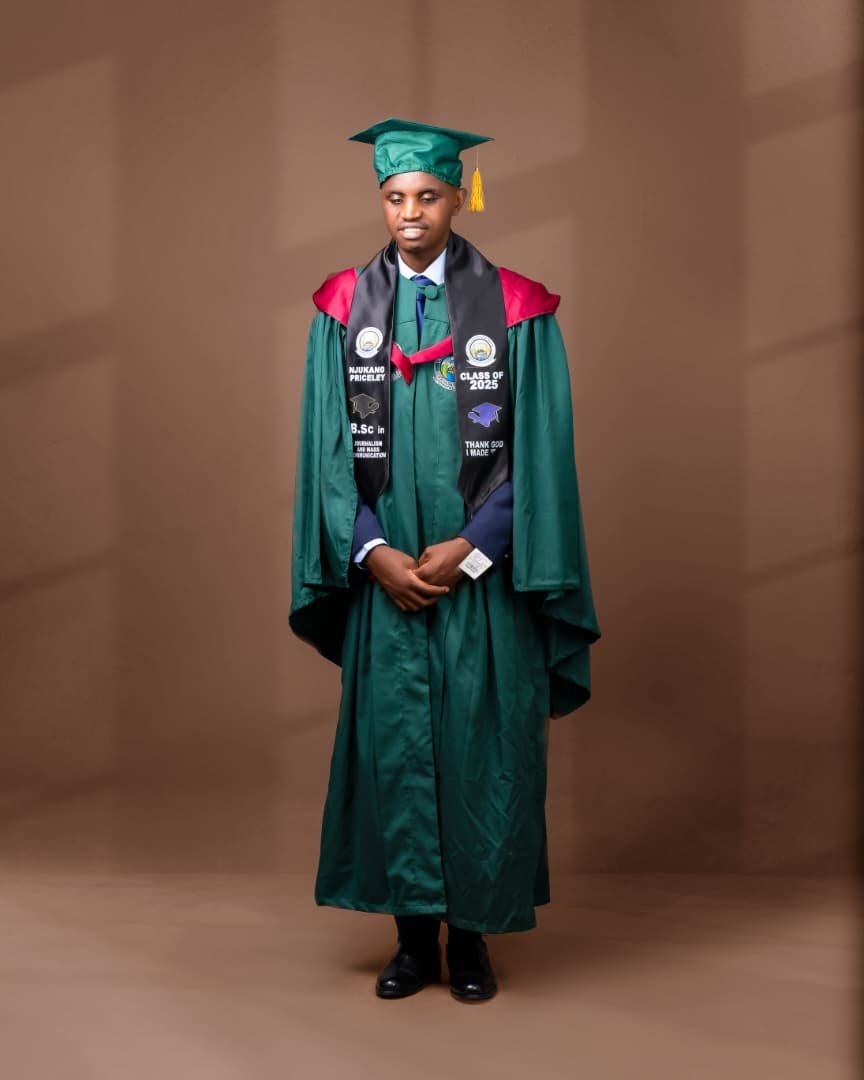
“My students are too busy to contribute money for you today.” This is the kind of reception Princeley Njukang, a blind Cameroonian undergraduate student, received from a lecturer the first time he appeared in a lecture hall. He was judged and condemned solely on the basis of using a white cane. These experiences, and many others, would fuel his zeal to work his way to the top, graduating as the best student from the University of Buea’s Department of Journalism and Mass Communication (JMC).
The opportunity to access formal education is, to Njukang, a miracle. Attaining university education and breaking records to become the all-time best graduate in the JMC department, he says, required courage. He recounts moments when he toiled, sweating through pain and rejection. “Persons with disabilities must be willing to write their story with boldness and pride, refusing to be defined by the reductive narratives of society,” the young graduate reveals in an exclusive interview with Disability News Africa (DNA), where he shares his life story.
Dreams Planted on Rocky Soil for Years
Njukang began nursing hopes of becoming a journalist at a very tender age, but the lack of support soon plunged him into hopelessness. Listening to radio news and imitating his favourite presenters characterised his childhood. He shared his ambition many times with his maternal grandmother, but the fact that he could not see reduced the dream to mere fantasy. To his family, it seemed too big for a blind child who could not go to school.
Njukang stayed home for ten years, sowing seeds that never germinated. “I grew up being told I could never go to school because I am blind. I believed the narrative because years passed and I was home, only dreaming,” he recounts, his face wrapped in nostalgia.
Destiny Delayed, Not Denied
While children of his age were in school, Njukang spent his days at home listening to radio news. Unsure what else to do with a child who walked and spoke like a journalist despite never having attended primary school, his family decided to seek medical help in Buea, the capital of Cameroon’s South West Region, hoping for a rare chance of restoring his sight.
When the doctor emerged from the consultation room smiling, Njukang’s uncle, who had accompanied him, expected obvious news. Instead, the reverse was announced. The medic advised that Njukang be enrolled at the Rehabilitation Institute for the Blind, a government-run special school in Buea. Hesitantly, he was taken to the centre in 2014.
Opportunity Clouded in Challenges
Njukang finally had the chance to sit in a classroom. His passion for education helped him grasp Braille reading and writing—used widely by blind people around the world—within a short period. However, before long, he was reminded that no place is truly safe for people like him. From his family to his village community and school environment, Njukang says stigma and exclusion followed him.
From the moment he stepped into a classroom, he recalls, it became a battle against a society that refused to accept him for no reason other than his blindness. He recounts painfully the day he sought admission into secondary school at Government Bilingual Grammar School, Buea. “The principal told me to go home or look for another school that could accept people like me,” he says, his voice trembling. Attempts by DNA to reach the former school administrator proved unsuccessful.
Three years ago, Njukang graduated as one of the best students from Government Bilingual Grammar School, where he fought through to completion before gaining admission into the University of Buea to study Journalism and Mass Communication—the career of his childhood. It appears Njukang had been preparing from birth to become a voice for Africans with disabilities, a mission he now pursues through solution journalism.
With pride and boldness, Princeley Njukang walked into his first university lecture, only to be met with an insult that opened his blind eyes to realities beyond radio broadcasting. From that moment, he understood that narratives would only change if persons with disabilities learned to tell their own stories. “My students are too busy to contribute money for you today,” the lecturer’s words struck him like a bullet.
Yet Njukang refused to surrender. Instead, he armed himself with resolve, knowing the struggle for educational and professional success had only begun.
In his early university days, he often fell while navigating the inaccessible campus. Students laughed and called him names. “That beggar has come again,” they would say. “I would miss my class, enter the wrong hall, and the way I was sent out was as if I were a dog,” he recounts bitterly. At times, after sitting for examinations, he found no results published. When he complained at the transcript office, he was told that even if he had written the exams, he would never have succeeded.
To some, these accounts may sound exaggerated. Yet this is a daily reality for many students with visual impairment across Africa. For Njukang, the triumph is not merely surviving these challenges or graduating on time. It is graduating with First Class Honours, topping his class, and becoming the best graduate the department has produced since its creation in 1993.
“With pride and honour, I dedicate this success to all persons with disabilities facing challenges similar to mine,” he says, smiling as he reflects on a long journey crowned with success.
What the Success Means to the Department of JMC
Speaking at a recent event in Buea to recognise Njukang’s achievement, the Head of the Department of Journalism and Mass Communication, Dr Lizzie Nengieh, described him as “a genuinely intelligent student who is passionate about everything he does.” She noted that his success did not come as a surprise, explaining that he set exceptionally high standards from his first year.
“He was the kind of student I taught, and when I got tired, I would call on him to take over and teach his course mates,” she disclosed, her face lit with pride.
Dr Nengieh added that Njukang’s record-breaking achievement would be remembered for generations. “In fact, our doors are wide open for other students with visual impairment who will follow after Njukang,” she declared with hope.
Enters FUHOSEA; A Moment of Community Recognition
During the event, the Executive Director of the Foundation United for Handicaps, Orphans and Street-Children of Ekona Area (FUHOSEA), an organization advancing inclusive education and socioeconomic development for persons with disabilities, praised Njukang for his remarkable ability to blend schoolwork with community development activities. He noted that Njukang’s success speaks to his discipline and commitment—traits that drew the organization to begin supporting him through school in 2019.
“While he was in school, if we needed results to impress funders, his would be the most useful. He has been consistently excellent,” he said. “We would like to keep supporting him wherever he decides to go from here.”
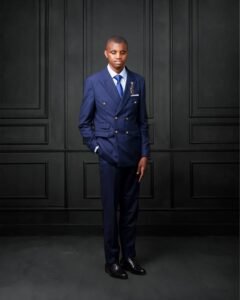
In August 2025, Njukang was appointed pioneer Communications Officer for FUHOSEA. In that role, he has been working to amplify the organization’s work.
Journalism for Change Campaign
Even before completing his studies, Njukang understood that the media is a powerful weapon for dismantling negative narratives about persons with disabilities. “I feel fulfilled telling the stories of disabled people, because only then shall we be free from society’s chains,” he says.
Currently, Njukang serves as Desk Editor at Disability News Africa, where he uses solution journalism to build bridges toward inclusive communities across Africa.
 Njukang Princeley