
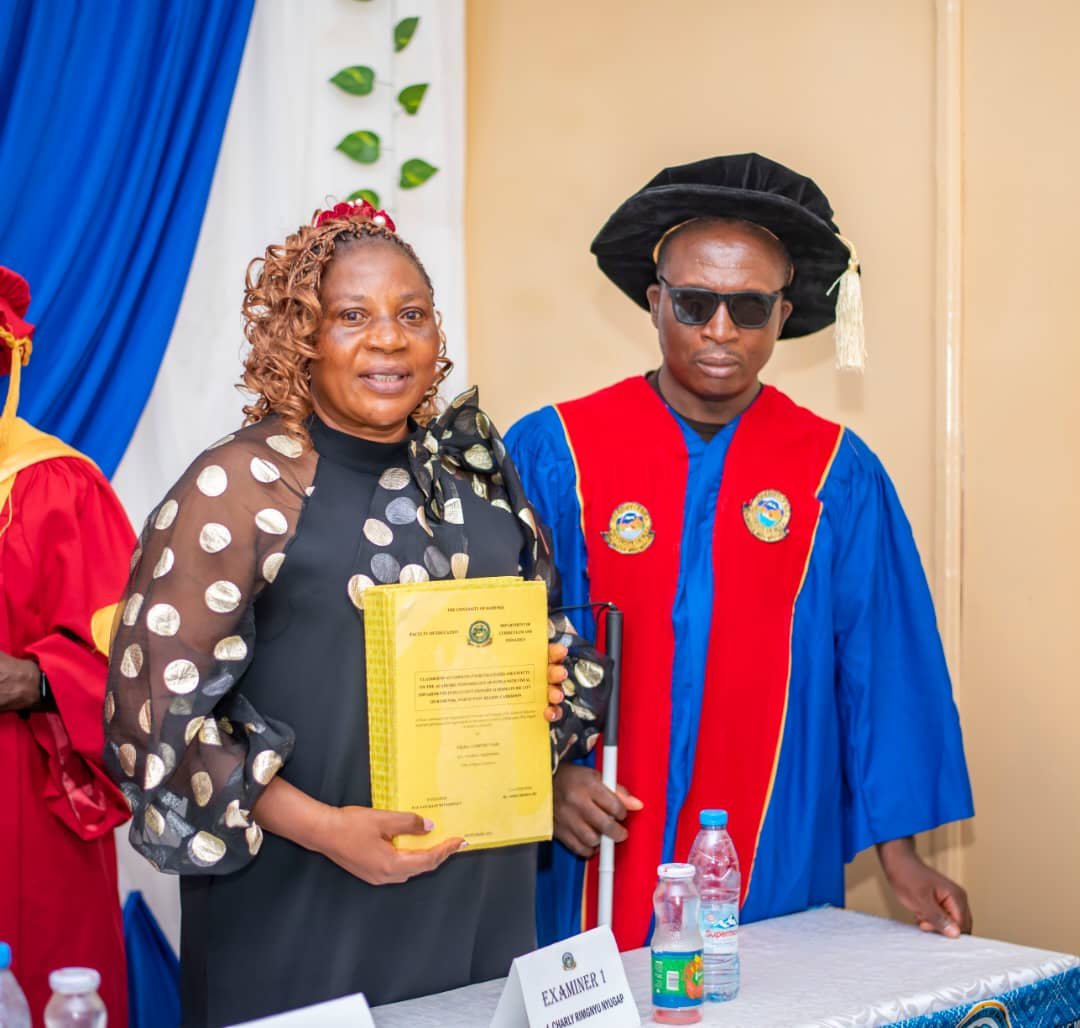
By Princely Kesah, Cameroon
The drive for inclusive education in Cameroon may be gradual, but history was made recently with the country’s first-ever doctoral thesis defence examiner with a visual impairment. Professor Charley Nyugap, Associate Professor of Special Needs and Inclusive Education, recently served on the examination panel at the University of Bamenda (UBA).
The university don examined a thesis defended by Comfort Yigha, titled “Effectiveness of Classroom Accommodation Strategies on the Academic Performance of Pupils with Visual Impairment in Inclusive Primary Schools in Bamenda.” Professor Nyugap is the first lecturer with a visual impairment in Cameroon to serve in such a capacity.
Recruited by the University of Buea in 2007 as an assistant instructor, Professor Nyugap has steadily risen to become an Associate Professor. Both the Universities of Buea and Bamenda, Anglophone institutions, are located in Cameroon’s English-speaking Southwest and Northwest regions.
Blind for over forty years, Professor Nyugap reflected on the challenges he faced accessing elementary education while engaging in a deep intellectual dialogue with the candidate. For nearly 30 minutes, he exchanged insights with Yigha to strengthen the research, which he described as timely, relevant, and critical for transforming inclusive primary education—the foundation of learning in Cameroon.
Core of the Study
A veteran Basic Education teacher in Bamenda, Comfort Yigha has witnessed firsthand the challenges faced by learners with visual impairments. She believes these students could excel if proper teaching and learning strategies were adapted.
“I saw in most of these children the zeal to learn, but their results were never outstanding—not because they lack intelligence, but because the learning environment did not meet their needs,” Yigha told DNA in an interview.
In her study, Yigha divided learners into control and experimental groups. Initially, both groups worked without any adapted classroom support, and their performance was recorded. Then, only the previously tested experimental group received support. A second test was administered to both groups to assess any improvement. Focus group discussions with pupils and interviews with teachers provided additional context.
The findings demonstrate that simple classroom modifications—such as large print materials, Braille, aural tests, seat adjustments, and extra time—significantly improve the performance of children with visual impairments. Yigha strongly recommends that “these strategies be incorporated into both pre-service and in-service teacher training programs so that accommodation becomes standard instructional practice rather than optional adjustments.”
Implications for Disability Inclusion
Speaking to DNA after the rigorous defence session, Professor Nyugap said the moment marks a turning point for higher education in Cameroon. Examining a doctoral thesis, he said, sends a message of hope for younger academics with visual impairments.
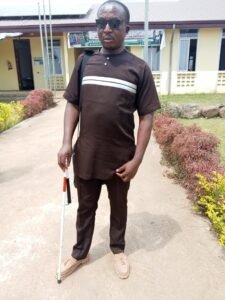
“It is good to talk the talk of inclusion, but it is even better to walk the talk,” he emphasized, stressing that higher education stakeholders must actively leverage the abilities of persons with disabilities to advance the sector.
The professor highlighted that his milestone offers motivation and recognition for the three other junior lecturers with visual impairments currently serving in the Universities of Bamenda and Buea. “This bold step is a source of motivation, recognition, and valorisation of our dignity as academics with disabilities,” he said.
Reflecting on the broader situation for persons with disabilities in Cameroon, Professor Nyugap urged the government to not only train but also recruit youth with disabilities across all sectors, cautioning that training without opportunities to serve the country is meaningless.
Inclusion: Intentional, Not a Gamble
The University of Bamenda, the eighth of Cameroon’s eleven state universities, has a proven track record of promoting disability inclusion, setting a benchmark for national development of inclusive education.
Professor Peter Agborbechem, Panel Chair and Dean of the Faculty of Education, told DNA that the university deliberately designs programs to accommodate learners with diverse impairments and actively recruits persons with disabilities for academic roles. “We collaborate to improve the quality of teaching and learning for students and staff with visual impairments. I encourage others to know that there are no limits to their dreams,” he said, emphasizing his commitment to actualizing the recently defended thesis findings.
Sustainability of Inclusive Practices
Professor Agborbechem added that Braille and Sign Language short certificate courses will soon begin at the University of Bamenda. Advanced equipment, including Braille embossers, has been ordered to support the programs. “We don’t just talk about inclusion; we implement programs to ensure education is accessible to all, regardless of disability,” he said passionately.
He described Professor Nyugap as “an indigenously intelligent academic whose contributions are a tremendous asset to Cameroon.” This collaboration between the dean and Professor Nyugap began years ago at the University of Buea, where the dean recognized Nyugap’s scholarly potential and sponsored him to attend an international workshop.
Silver Lining in a Dark Cloud
While the application of Comfort Yigha’s findings across Cameroon remains to be seen, her supervisor, Professor Lilian Fai, described the thesis as groundbreaking. She stressed that practical, developmental research like this is vital to improving the lives of persons with disabilities.
The study was defended in the Department of Pedagogy and Curriculum, Faculty of Education, at the University of Bamenda. Doctor Yigha expressed gratitude to the university for selecting an examiner with a visual impairment, noting that it added meaning and significance to the milestone.
 Nyaradzo Chitungo
  Njukang Princeley