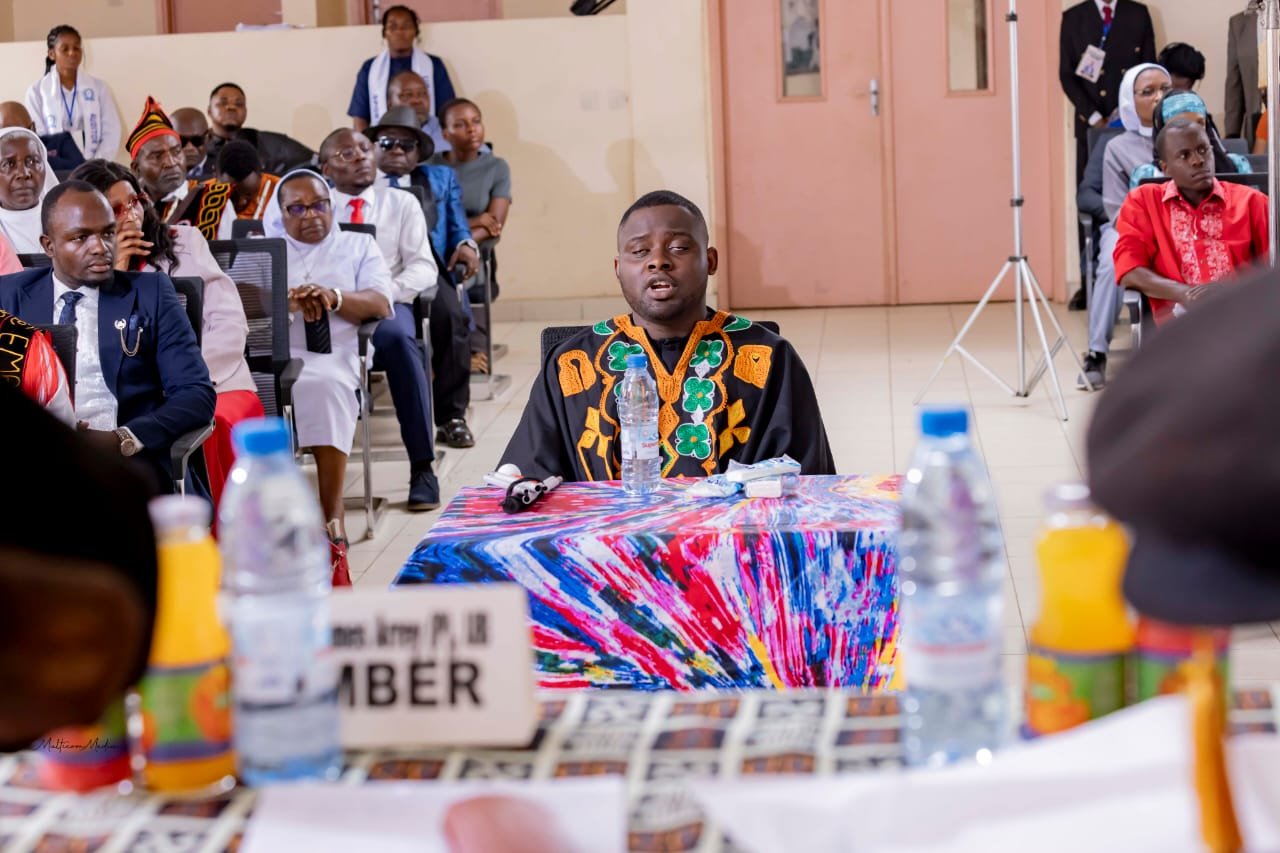
A PhD study titled Accessing Mass Media During Conflicts: Needs and Challenges of Persons with Visual Impairment in the Cameroon Anglophone Conflict, defended at the University of Buea, has brought to light the deep and often overlooked barriers faced by persons with visual impairment in accessing essential media information during the ongoing Anglophone conflict in Cameroon.
The study, authored by Dr. Kesah Princely, a journalist and Lecturer of International Relations and Conflict Resolution, shows how gaps in media accessibility leave visually impaired persons exposed, uninformed, and at times dangerously vulnerable. In conflict settings where information can determine survival, the absence of accessible media places persons with visual impairment at a heightened risk of harm.
Information as a Matter of Survival
Drawing from in depth interviews with 20 persons with visual impairment and 11 media professionals in the North West and South West regions, the research paints a sobering picture of exclusion. Dr. Kesah explains that the lack of accessible radio programming, television content, and inclusive digital media has worsened the humanitarian situation of visually impaired persons during the crisis.
“Without access to timely information about what is happening around them, persons with visual impairment are often trapped in dangerous situations,” he explains. “Some are abducted or killed simply because they could not receive critical updates such as curfews, evacuation warnings, or information about safe areas.”
For many participants in the study, the inability to independently access information meant relying entirely on others, a dependency that becomes perilous during moments of chaos and displacement.
Disability and Displacement in Conflict Zones
Since the outbreak of the Anglophone conflict in 2017, persons with disabilities have faced compounded humanitarian challenges. Rights organizations have repeatedly warned that this group is often excluded from emergency planning and humanitarian response.
Dr. Kesah noted cases where persons with disabilities were kidnapped, tortured, or killed. In some instances, when armed groups or military forces entered communities, non disabled residents fled, leaving those with disabilities behind, unable to escape.
“In conflict, disability magnifies vulnerability,” Dr. Kesah notes. “When systems are not designed with inclusion in mind, people with disabilities pay the highest price.”
Media Exclusion and the Digital Divide
While radio remains the most accessible medium for many visually impaired persons, the study found that television and social media platforms largely remain inaccessible. Many broadcasts lack audio descriptions, while digital platforms often rely heavily on images, graphics, and videos without alternative text.
“There is a serious gap in inclusive reporting,” Dr. Kesah observes. “When media content is produced without accessibility features, visually impaired persons are effectively shut out of public information.”
Although assistive technologies such as screen readers offer some support, the study highlights persistent challenges. Rapid digitalization, incompatible media formats, and limited digital literacy continue to deepen exclusion.
“Technology should be a bridge, not another barrier,” Dr. Kesah says. “But when platforms are not designed with accessibility in mind, these tools fail the people who need them most.”
Law Without Enforcement
Despite the existence of legal protections, including the United Nations Convention on the Rights of Persons with Disabilities and Cameroon’s 2010 Law on the Protection and Promotion of Persons with Disabilities, the study reveals weak enforcement in practice.
“The laws exist on paper, but they are not felt in the daily lives of persons with visual impairment,” Dr. Kesah explains. “Without enforcement and accountability, these frameworks do little to change realities on the ground.”
He calls on regulators, media organizations, and policymakers to move beyond symbolic commitments and adopt concrete inclusive practices, especially in conflict affected regions where access to information is critical for survival.
Academic and Professional Recognition
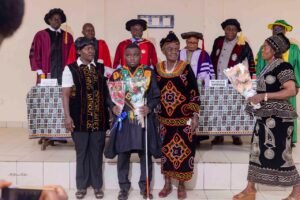
Dr. Kesah’s work has drawn praise from academic peers for addressing a long neglected intersection between disability, media, and conflict. Dr. Kesah and supervisors, shortly after defense
Professor Atancho Nji Akonombo, Chairperson of the Defense Panel and Dean of the Faculty of Laws and Political Science at the University of Buea, described the research as a crucial contribution to both media studies and human rights discourse.
“This study highlights the responsibility of the media in ensuring accessibility, particularly in conflict zones,” he noted. “It advances the idea of an inclusive society where everyone can access vital information.”
Professor Sunjo Emile, one of Dr. Kesah’s supervisors, also commended the interdisciplinary approach of the research, which frames media accessibility as a human rights concern rather than a technical afterthought.
Advocating for Inclusion/
A close reading of Dr. Kesah’s thesis and his broader body of work reveals a deep concern for how persons with disabilities are treated in society. He argues that disability is often socially amplified through exclusionary systems, attitudes, and structures.
“Until we begin removing the barriers we have designed into society, discrimination and marginalization will persist,” he says. Kesah poses with the Rev. Sister that encouraged his academic journey
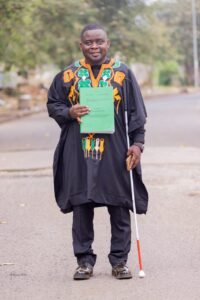
Dr. Kesah’s advocacy is shaped by lived experience. Blind from childhood, he grew up in an environment where his potential was dismissed long before it could be tested.
“They told me I could not go to school, that I was not a normal child,” he recalls.
Hope emerged when the Reverend Sisters of St. Francis visited his community and encouraged his grandmother to enroll him in school. His thesis is dedicated to her.
“She believed in me when no one else did,” he says. “She supported my education with money from selling potatoes. Without her, this journey would not have been possible.”
In Cameroon, only one in ten children with disabilities has access to education, according to the Cameroon Baptist Convention Health Services. Dr. Kesah notes that this educational exclusion further limits access to information during crises, since most media content assumes a basic level of literacy.
“It means we must approach disability issues systemically,” he explains. “Not through one off charity gestures, but through structural change.”
Moving Forward
According to Dr. Kesah, persons with disabilities in Africa have long been sidelined in media, both as professionals and as audiences. In response, he founded Disability News Africa to help reshape disability narratives and center African voices and experiences.
Through the platform, he documents underreported disability stories across cultures and conflict zones, including the ongoing humanitarian struggles in Cameroon’s North West and South West regions.
Through his organization, the Foundation for the Inclusion and Empowerment of Persons with Disabilities, he has provided humanitarian assistance and skills training to hundreds of affected persons with disabilities. Dr. Kesah with his PhD Thesis
With his PhD now completed, Dr. Kesah says the work is far from over.
“We will take this conversation into classrooms, media houses, institutions, and government spaces,” he says. “Disability advocacy is not a side project for me. It is my daily bread.”
His research stands as both a scholarly contribution and a moral call, reminding society that access to information is not a privilege, but a right that must extend to everyone, especially in times of crisis.
Princeley Njukang is a Cameroonian journalist, writer, and social impact advocate dedicated to amplifying voices often unheard. He focuses on disability rights, using storytelling to influence both public perception and policies affecting persons with disabilities.
As News Editor for Disability News Africa, he works with the managing editor to shape newsroom policy, identify compelling stories, and write or commission articles.
Princeley holds a B.Sc. (First-Class Honours) in Journalism and Mass Communication from the University of Buea, where he also served as Manager of Chariot Radio and Editor-in-Chief of the Chariot Newspaper. His work regularly features on Cameroonian news outlets.
Contact: Njukangprinceley@gmail.com or via social media.

 Princely Kesah