
Princely Kesah, Cameroon
In his early twenties, Francis Tanifum had huge dreams. Little did he foresee that the very promising future he worked so hard for would later leave him in ruins.
Like a sharp, hot knife cutting through butter, his vivacity came to an end in the least expected way. If you have ever read fiction or watched films where a man with great potential suddenly becomes blind while sitting his final university examination, then you were seeing reality in anticipation.
In 2013, Tanifum was sighted. As a Biology teacher in training, he worked tirelessly to complete his studies and join the workforce. His goal was simple but profound: to become a successful young man who would add value to his family and society.
During what appeared to be his final examination session, Tanifum suddenly lost his sight after receiving the question paper that morning.
“I just discovered I could no longer see,” he recounts, his face wrapped in bewilderment as he recalls the moment he was thrown into depression.
Twelve years later, Tanifum looks back with joy and thanksgiving. Losing his sight helped him locate his life’s purpose.
For an entire year, he stayed home weeping and trying to understand what would become of the years he had invested in university education. He asked many questions and found few answers.
Just when he thought everything had gone down in ruins, life began again, this time in a more refreshing way, even as a completely blind man. This turning point came in September 2014.
Destiny Delayed, Not Denied
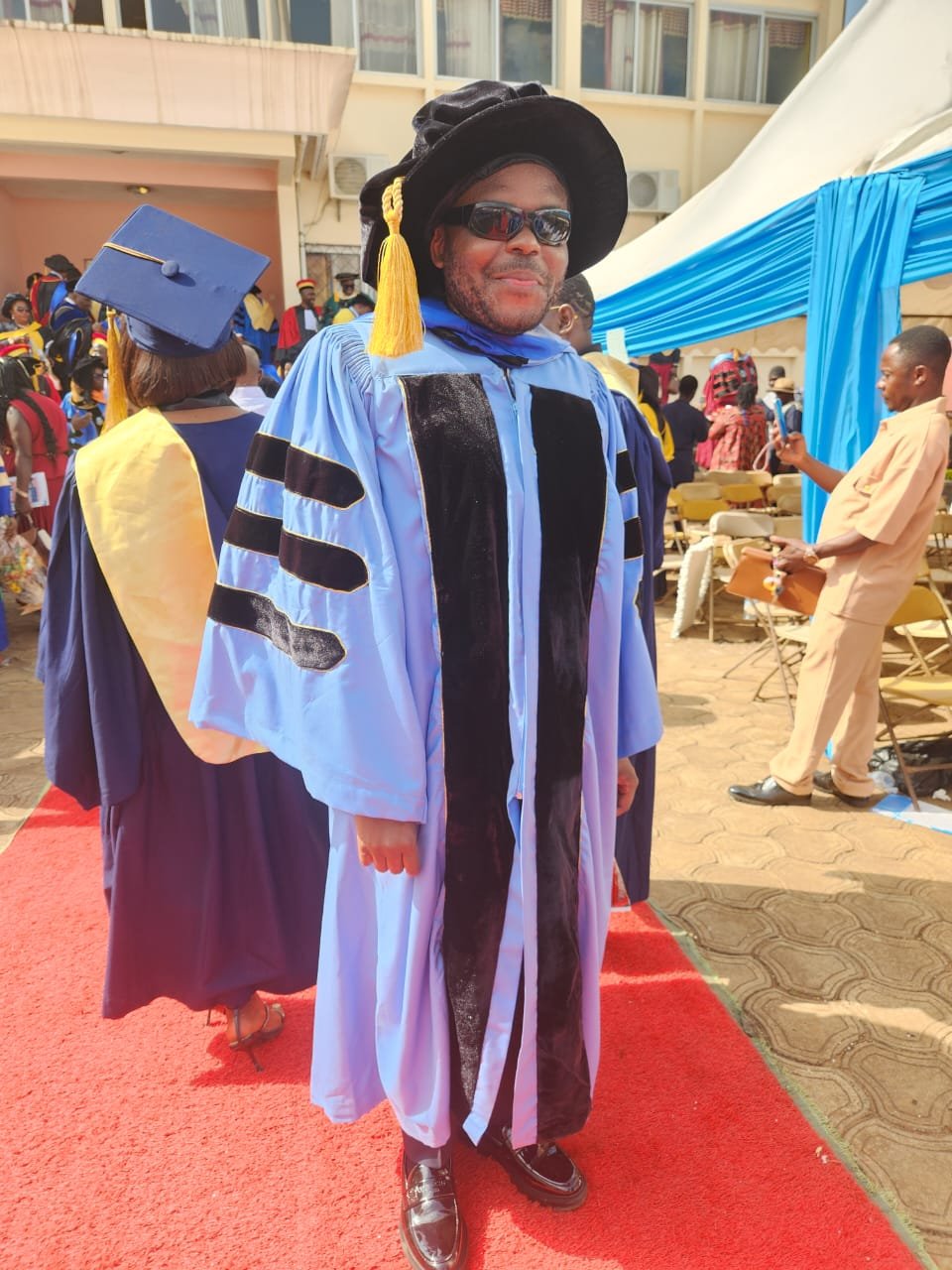
Francis Tanifum has now made history for himself and the disability fraternity in Cameroon. He became the first person with visual impairment to obtain a Doctor of Philosophy degree from the University of Bamenda in the North West Region.
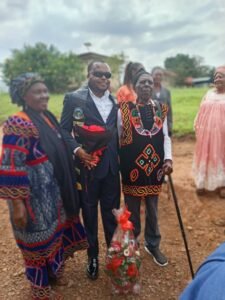
His recently defended thesis in Applied Developmental Psychology, titled “Psychosocial Support and Adolescent Deviant Behaviours in Some Selected Secondary Schools in Mezam Division,” demonstrates how personal challenges can evolve into a lifeline for humanity.
“The depression, trauma, and isolation I experienced after losing my sight, alongside the psychosocial support from my family and friends, inspired me to carry out this study,” Doctor Tanifum explains.
He adds that many people in similar conditions lack the support he benefited from after losing everything.
The researcher says he has long been troubled by the growing rate of deviant behaviours in schools. These behaviours, he notes, affect the learning environment through sexual violence, fighting, theft, gambling, and declining academic performance.
According to Doctor Tanifum, the persistence and severity of these behaviours, despite the government’s Clean School policy, make insecurity in schools a national concern.
This concern formed the core of his doctoral research, which employed a mixed research method.
Key Contributions to Knowledge and Recommendations
The findings revealed that most students benefit significantly from parental, peer, and community support.
The study established that investment in children’s education begins within the family, which remains the basic unit of society.
“
Parents and caregivers must understand that their role in shaping who children become is pivotal,” Doctor Tanifum says. “They are key stakeholders and must play their part.”
The research also revealed that deviant behaviours can be reduced when parents and teachers apply appropriate punishment alongside effective problem-solving mechanisms.
According to the scholar, not all deviant behaviours require force. Positive approaches can help children abandon harmful practices.
“Set rules together with children so they already understand that negative consequences follow specific wrong actions,” he explains.
Doctor Tanifum further recommends positive reinforcement as an essential tool for curbing deviant behaviours in schools.
He adds that parents and teachers can remove triggers that cause misbehaviour, helping children correct themselves without resorting to punishment.
Peer bonding emerged as another effective strategy. Stakeholders, he says, should encourage healthy peer relationships.
This approach contrasts with negative social interactions, which the study found often generate harmful influences.
As the saying goes, “Show me your friend and I will tell you who you are.”
The thesis comes at a time when deviant behaviours are rising in secondary schools across Cameroon.
Doctor Tanifum believes the research can help if stakeholders apply its findings consistently.
“Parents, community leaders, and teachers need a collective and uniform approach,” he explains. “If the same mechanisms are enforced at home, in the community, and at school, students will understand that it is serious business.”
Significance for Disability Inclusion and the University of Bamenda
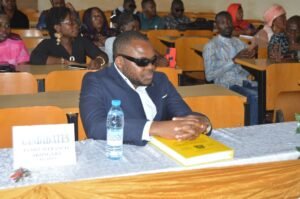
Speaking to DNA shortly after the doctoral defence at the University of Bamenda campus in Bambili, Professor Sarah Nsagha, his supervisor, described the work as original, relevant, pertinent, and timely.
She noted that deviant behaviours in schools are no longer abstract concerns, as they are increasingly visible and documented.
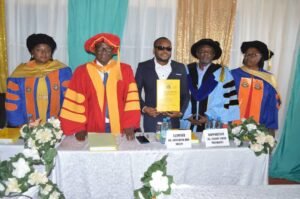
Professor Nsagha emphasized that this first doctoral thesis defended by a visually impaired candidate at the University of Bamenda represents a major milestone.
She said it is significant not only for disability advocates, but also for the university and the country at large.
“We have had students with visual impairment at different levels in this university,” she noted. “This thesis stands as a symbol of hope and encouragement for others aspiring to reach such heights.”
The professor described Doctor Tanifum as an excellent young researcher whose work has left lasting imprints on the institution.
She added that his achievement serves as a benchmark for inclusive academic practices at the University of Bamenda, established in 2010.
Rocky Start, Decent Future
Many people who lose their sight struggle to recover from depression. Doctor Tanifum’s journey underscores the importance of parental support and encouragement.
In 2015, he accepted his new identity as a blind man who might never regain his sight.
He enrolled at Saint Joseph’s Children and Adult Home, known as SAJOCAH, a rehabilitation centre in Bafut in the North West Region.
There, he learned to read and write Braille, a writing system widely used by visually impaired persons worldwide.
This decision became the foundation upon which his life is now anchored.
“I saw many blind persons, including children below ten years, running, playing, and living happily like sighted people,” he recalls.
He says this experience gave him the confidence to rewrite his own history.
While at the rehabilitation centre, Tanifum learned how to use adaptive computers.
He later spent several months teaching his peers before gaining admission to study Educational Psychology at the University of Buea, Cameroon’s first Anglophone university.
After two years, he earned his Bachelor of Science degree, building on the Biology diploma he obtained the same year he lost his sight.
Upon graduating in 2018, he enrolled in a Master’s programme in Educational Psychology.
In 2021, he gained admission for doctoral studies at the University of Bamenda.
From Depression Victim to Therapist
Disability inclusion in Cameroon remains limited. Acquiring visual impairment later in life and receiving consistent family and social support is still uncommon.
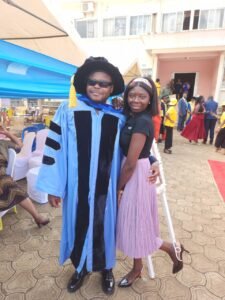
Having overcome this phase, Doctor Francis Tanifum understood that his story would only be meaningful if it served others.
He resolved to help people who might never have anyone to help them see beyond life’s challenges and rebuild confidence and self-efficacy.
Between 2018 and 2020, he trained as a Guidance Counsellor at the Higher Teachers Technical Training College of the University of Bamenda.
This training equipped him for advocacy and professional service.
After graduation, he was posted as a secondary school counsellor, a role that allowed him to witness deviant behaviours firsthand.
These experiences directly shaped his doctoral research.
Today, Doctor Tanifum is not only a researcher and guidance counsellor.
He is also a brand ambassador for persons with disabilities who feel excluded and depressed.
Doctor Francis Tanifum Akonwi stands as a mender of broken dreams, a man who journeyed from deep depression as a blind young man to becoming a therapist for others facing similar struggles.
 Njukang Princeley